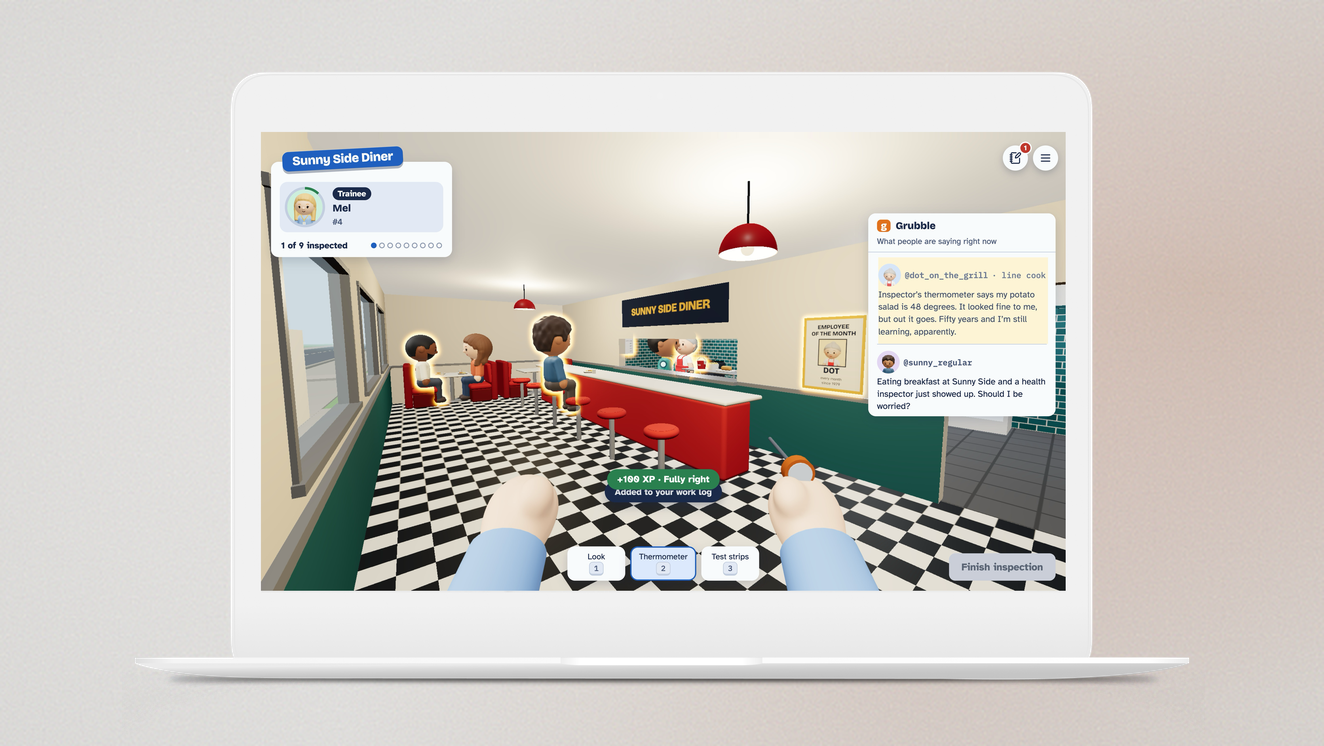
Teaching Judgment Through a 3D Inspection Game
To improve Food Code judgment through realistic practice.
Play Grade Pending ↗︎ROLE
Solo project
STATUS
Playable now, still in testing
EARLY DATA
59 playtesters; they find 78% of violations, cite and rate 36% correctly
Business Goal
Restaurants get a grade in their window based on a health inspection, and customers see it before they decide whether to come in. That grade comes from FDA Food Code violations, which add up to a score.
In Grade Pending, a trainee has to identify the violations in the kitchen, rate how serious each one is, and identify the things that are not violations. After that, they give the restaurant a grade based on the violation totals.
What we are measuring is how often a trainee cites the correct Food Code violation and rates its seriousness correctly. Sunny Side Diner has six violations and three items where nothing is wrong. Fifty-nine people played Sunny Side Diner between November 17 and November 21, 2026, with each of the nine items judged by between 19 and 31 of them. Across those plays, trainees identify a violation and rate its seriousness correctly 36% of the time, and correctly leave the three fine items alone 81% of the time. The target is to raise how often trainees cite the correct violation and rate its seriousness correctly from 36% to 72% by the fifth restaurant.
Five restaurants are planned so trainees get enough practice to improve, and so there is enough data to show that improvement. One restaurant only gives us evidence pointing to where our skill gaps may be.
Problem Statement
Assume a trainee is familiar with the FDA Food Code. Using the Food Code in a kitchen is a different skill, and that skill is really three skills stacked together.
The first is taking a reading on an item you cannot judge by looking, and knowing the number that reading has to meet. Potato salad on a prep table looks the same at 48 degrees as it does at 41 degrees. A sanitizer bucket looks the same whether it is mixed strong enough to kill bacteria or not. A trainee has to use a thermometer or a test strip on these items, and then has to know what the Food Code requires.
The second is judging which Food Code rule a violation breaks and how serious it is: a public health hazard, a critical violation, or a general one.
The third is grading the restaurant from the violation total. Each level of seriousness adds a different number of points, so a trainee has to total them and work out which grade that total comes to.
Skills like this are usually taught with compliance training, which is not what Grade Pending is. Compliance training gives people a lot of information without being able to help them practice, and usually ends with a quiz. A quiz only shows knowledge transfer, not application. A trainee passes the quiz, then walks into the environment without having practiced right before they need to apply what they learned. People forget what they do not practice, so by the time someone needs the training, much of it is gone and the judgments they make are wrong more often.
Solution
Grade Pending puts the learner inside the kitchen to practice, so they can apply what they learned on the job soon after. You are an inspector reporting for duty at Sunny Side Diner. You walk the kitchen and check each thing in it, deciding when to reach for a thermometer or sanitizer test strips, whether what you find breaks the Food Code, and how serious it is. Two things give you feedback after each decision. Rosa Delgado, a senior inspector, tells you whether you were right and what the correct answer was. Grubble, the town's restaurant review app, fills with posts from customers and staff reacting to what you decided. Both come immediately, so you are reinforced on what you got right and corrected on what you got wrong while the decision is still fresh.
By the time you grade the restaurant, you know which items were violations and how serious each one is. Rules follow the FDA Food Code (2022) and grading is modeled on New York City's restaurant grading system. You still have to total the points and work out which grade that total comes to.
Four awards per restaurant track the behaviors that make a grade defensible: taking every temperature before deciding, citing nothing that is fine, catching the raw chicken stored above the lettuce, and giving the correct grade.
Built in Three.js and delivered as an xAPI package. It is hosted and launched through Build Capable XCL, which handles the learner launch, the sign-in form, and the learning record store. Every decision reports back: what a trainee did with each item, whether they picked the right reason, whether they rated the seriousness right, whether they cited something that was fine, and the grade they gave against the correct one.
What the Data Shows
Fifty-nine people played Sunny Side Diner between November 17 and November 21, 2026. Each of its nine items was judged by between 19 and 31 of them.
For every item, a trainee decides whether it breaks the Food Code. If they say it does, they pick which violation it is and how serious. Across the six violations, trainees get both right 36% of the time. On another 42% they say it is a violation but cannot pick the right one or the right seriousness.
Each of the six violations at Sunny Side Diner. The three items that are not violations are not shown here.
- CORRECT cited the correct violation and the correct seriousness
- MIS-CITED said it was a violation, but cited the wrong one or the wrong seriousness
- MISSED did not say it was a violation, but it was one
Each bar is everyone who judged that item, so the three numbers add to 100%.
The three items at the top are the standards most trainees already know: hot food at 135 degrees or above, cold food at 41 degrees or below, and raw chicken stored below the lettuce so it cannot drip onto food that is eaten raw. The three at the bottom need a standard most trainees do not know: sanitizer has to read at least 50 parts per million, a handwashing sink has to stay clear of dirty dishes, and a cook with symptoms has to stay home. On every item that needs a tool, 90% or more of trainees used one. A test strip tells a trainee what the sanitizer bucket reads, and the trainee has to already know what that reading has to be. 91% took a reading from the bucket, and one in ten cited it correctly.
Three of the nine items are not violations. The soup, the milk and the tuna salad are all within the Food Code, so the correct move is to cite nothing. Between 20 and 22 trainees judged each of those three. 81% correctly left them alone, and 19% cited a violation that was not there.
Seventeen trainees finished an inspection and gave Sunny Side Diner a grade. Its violations add up to a C, which is the lowest grade in the game. Ten gave it a C, five gave it a B, and two gave it an A. The grade comes from the points a trainee recorded, so every violation they missed or under-rated moves the restaurant toward a better grade.
To see whether trainees improve with practice, we need the same data from the other four restaurants we plan to release.
Why It Scales
Only the restaurant changes between games. Everything else is reused: a 3D kitchen you walk through, a thermometer and sanitizer test strips that give a reading, a mentor who corrects each decision as you make it, and a review app where customers and staff post about what you decided. Every item asks the same four questions: does it break the Food Code, which violation is it, how serious is it, and what grade do the violations add up to. Every decision writes an xAPI statement that records whether the trainee took a reading first, whether they cited the right violation, and whether they rated the seriousness right.
The same engine works for any job where someone walks into a space, works out what they are looking at, and has to classify it. A delivery driver decides where a package is safe to leave. A technician checks a row of racks in a data center. A safety officer walks a warehouse floor. Building one of those means swapping three things: the 3D space, the rules the trainee applies, and the mentor who corrects them.
Access is the other constraint the game removes. Practicing on the job means finding a working kitchen that happens to have violations in it the day you need them, and a senior inspector free to walk it with you. Sunny Side Diner has the same nine items waiting every time, including the three items where nothing is wrong, and it runs for one trainee or for fifty on the same afternoon.
Grade Pending is the first game we have built on this engine. The next game starts with the engine already finished, which saves a lot of time.
Inside the game
5 screens. Select one to see it full size.